
Toward a World of Symbiotic Relationships between Products and Humans
Using the technology known as “programmable matter,”Associate Professor Akira Wakita is trying to achieve in real space what 3D computer graphics can do in cyberspace.
We asked him about the meaning and potential of this research, which he anticipates will play an important role in the real world as IT continues to advance.
WAKITA, Akira
Associate ProfessorFaculty of Environment and Information Studies
Matter WhoseShape Can Be Programmed
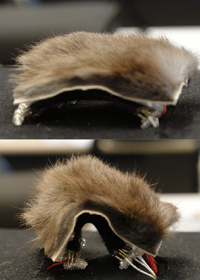 I am workingon what is known as programmable matter, that is, matter andstructures whose properties, such as their color or shape, can beprogrammed. I want to create a world where, for example, you can tellthe desk in front of you to become round and it will do so, or youcan stretch and tell the chair you’re sitting in “I’m tired”and the chair will recline. There are various approaches to creatingsuch objects, but the current trend among physicists is to build verytiny robots (“cells”) equipped with a motor and wirelessreceiver, and to create a system in which these cells all communicatewith one another and rearrange themselves into the desired shape. Atthis stage, since the individual cells are still large, the ensemblesthey form are quite sizable, but in the future it is expected thatclaylike modular robots will be realized with millimeter-scale units.My own work in this field involves what are known as “artificialmuscles,” or filaments of shape memory alloys; we embed these in atextile and change their shape by electronically controlling thecontraction of each “muscle.” In this way, we produce curvedsurfaces that change color and shape as programmed—something thathas long been possible on a display screen, but we are producing themin real space.
My Interestin 3D Modeling Grew Out of Yachting
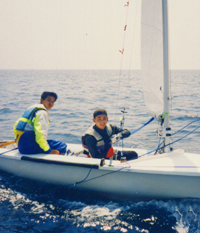 As anundergraduate at SFC, I was a keen yachtsman. It was the sailing thatappealed to me initially, but when one starts looking into how tomake a boat go faster, one finds oneself dealing with the shape ofthe keel, the shape of the sail, and so on. As a field, it’s fluiddynamics. At first I was merely curious, but I grew increasinglyinterested in fluids and curved surfaces, and when I looked into howsuch curves are made in reality, I encountered three-dimensional CADresearch. In my senior year I joined the lab of Professor HiroakiChiyokura, who is an expert in 3D CAD, and as a graduate student Iinvestigated modeling functions in 3D CAD. Related areas include thestudy of rendering in 3D computer graphics, and media art, and theseled me to 3D user interfaces, which are the basis of my presentresearch.
My Encounterwith Programmable Matter
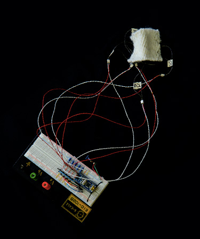 Aftercompleting my doctorate, I started a company and set to work oninterface design and media art. I was doing creative projects using,in particular, a format known as VRML for handling 3D on the Web.After I won the Grand Prix in the Nikkei Architecture Digital DesignCompetition, the work that came my way was mostly in 3D userinterface architecture and design. And then I was invited to comeback and teach at SFC. At the time, the SFC community was focusing onthe idea of creating not just software but real, tangible objects,and the research on wearable computing that I happened to getinvolved with at that point led me to do further studies usingfabric. Those studies evolved into the development of clothing thatcan change color under electronic control, and then to the work thatI mentioned earlier involving textiles that move under electroniccontrol. And what I am concentrating on now is programmable matter ingel form.
Slime thatMoves Like a Living Creature
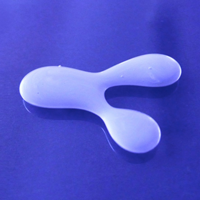 Slime can bemade by mixing laundry starch, borax, and water; perhaps you madesome as a child. By mixing magnetic powder into slime and placing itin a magnetic field controlled by a program, you can make it movelike a living creature. Technically speaking, it is a type of gelmagnetic fluid. You can control its form, so that it shape-shifts orbreaks up and comes together as programmed. This could be applied sothat when you type “Hello” on a keyboard, a blob of slime in realspace shapes itself into the letters H-E-L-L-O. Ultimately, by makingit possible to create more complex shapes, I hope to develop tools toassist architects and product designers. It would be fun if we couldhandle real space like 3D computer graphics.
The SolutionsExist in Nature
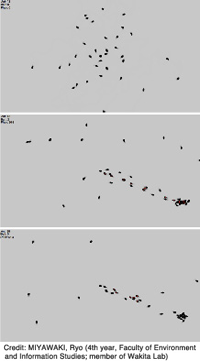 In addition,my laboratory is doing research that models and simulates themovements of organisms and the behavior of swarms. A famous exampleof this kind of simulation is ant colony optimization, or the seriesof events that ensue when ants discover food and bring it back to thenest, releasing a pheromone as they go. Simply by setting rules forhow each ant moves in response to external stimuli such as the foodand the pheromone, you can simulate the movements of the group. Muchof the intelligence found in nature is based on mechanisms thatcreate a solution by responding dynamically to the environment. Iwant to make products that imitate living things as a way ofexploring these natural mechanisms, rather than directly referencingany one thing found in nature. I want to make products that can existin a symbiotic relationship with human beings and coevolve with them,just like natural objects. As this research progresses, I think itwill lead to the ability to program things in real space withouthaving a negative impact on other environments. We are making newmaterials and structures that can replace the materials used inconventional architecture and product design.
A Wealth ofSeeds of Information Design
 One of theadvantages I notice at SFC since coming back as a faculty member isthat, by bringing together researchers in almost every field, ithighlights issues involving the interfaces between differentdisciplines. For example, following the diffusion of theinfrastructure provided by the Internet, and with intelligenttransport systems (ITS) being installed in our cars, in the future,spaces of every kind—our homes, our clothes—will be filled withinformation. And when that information, on various scales, begins toreach saturation point, it will be displayed in different waysaccording to its properties. The key will be the human interfaces,like those I am studying; these offer a wealth of seeds ofinformation design. Also, SFC provides an environment where we canjointly experiment with social applications. When one’s workreaches a phase where it has a potential social impact, one cancollaborate with researchers in the social sciences and conductsocial experiments. With advantages like this, I feel lucky to beable to do research at SFC.
A BriefBackground of Associate Professor
WAKITA, Akira
Associate Professor Wakita graduated in1997 from the Faculty of Environment and Information Studies, KeioUniversity. He earned his master’s degree in 1999 and his Ph.D. inMedia and Governance in 2002, both from the Graduate School of Mediaand Governance, Keio University. In 2004, he was appointed full-timelecturer in the Faculty of Environment and Information Studies, KeioUniversity, and in 2007 he became an Associate Professor. His fieldsof specialization are information design, smart materials, andthree-dimensional CAD and computer graphics. His major publicationsinclude Dezain gengo nyumon: Mono to joho wo musubu dezain no tame nishitte okitai koto (Learning design language: Basic knowledge fordesign that links objects and information) (Tokyo: Keio UniversityPress, 2009); as co-author, Models: Kenchiku mokei no hakubutsu toshi(Models: A museum city of architectural models) (Tokyo: University ofTokyo Press, 2010); and, as co-editor, Dezain gengo 2.0: Intarakushonno shikoho (Design language 2.0: How to think about interactions)(Tokyo: Keio University Press, 2006). Honors received include theExcellence Award in the Digital Design Category, 2003 Asia DigitalArt Awards, and a jury recommendation in the 2002 Japan Media ArtsFestival organized by the Agency for Cultural Affairs.
(14 January 2011)
Archive