
Linking with Providers for an Integrated, Interdisciplinary Approach to Medical Law and Ethics
Linking with Providers for an Integrated, Interdisciplinary Approach to Medical Law and Ethics
Advances in medical technology benefitus enormously,but they also raise new ethical andlegal challenges for health-care providers. We spoke withAssociate Professor Shoichi Maeda, whose interdisciplinaryresearch grapples with these issues from the perspectiveof professionals at the front lines of medical care.
MAEDA, Shoichi
Associate ProfessorGraduate School of Health Management
Tackling the Legal and EthicalChallenges
of Advanced Medical Technology
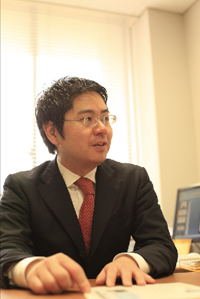 Thanks to dramatic advances in medicaltechnology in recent years, doctors are able to extend the lives ofpatients who formerly would have had no hope of survival. In manycases, such medical advances bring enormous benefits, but in others,the real value to the patient of advanced “life-prolongingtreatment” is questionable; it may simply not be what the patientwants. In these circumstances, we need to ask whether and when it ispermissible to withdraw or withhold medical care. Inasmuch as a deathresulting from suspension of medical care could potentially be deemeda homicide, such decisions can attract widespread media coverage andhave major repercussions for the treating physicians. In someinstances, the police have even intervened. End-of-life care issuesare not the only dilemmas facing health-care providers today.Advances in assisted reproductive technology and other fields haveraised a host of new ethical and legal questions that demand carefulstudy and examination. I have focused my teaching and researchefforts to date on the aspects of medical ethics and law that dealwith these questions.
Merging Legal and Medical Studies
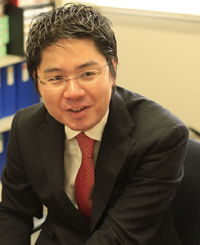 As an undergraduate student Iparticipated in an American law seminar offered by my university’sFaculty of Law. I became interested in the legal and ethical issuessurrounding end-of-life care and decided to analyze pertinent UScourt cases and laws and assess the status of end-of-life care inJapan. As I continued to focus on this and similar topics in graduateschool, I began to see that I could not limit myself to an academicapproach circumscribed by the study of law if I wanted to shed reallight on both the legal and ethical issues of medical practice. Ialso realized the need to bring to my research a detailed knowledgeof actual health-care settings and a solid grasp of social medicine,including an understanding of health-care systems. It seemed to methat the need for such an approach could only increase. I decided toenroll in the Graduate School of Medical Sciences where I did morethan just learn the basics of medicine; I worked hard (or, moreaccurately, was forced to work hard) to learn the methodology ofnatural-science research, from epidemiology and statistics to research design.
While studying law, I rarely had occasion toapproach a topic quantitatively and knew none of the fundamentals ofnatural-science research. As a result, my studies at the GraduateSchool of Medical Sciences were a struggle, at least at the outset.The more I continued my research, the more the importance of naturalscience research fundamentals became apparent. In the end I pursueddoctoral studies both at the Graduate School of Medical Sciences andat the Graduate School of Law, and what struck me most forcefully inboth cases was the importance of mastering the methodology of one’sfield if one wants to study a topic rigorously. At the same time, Ibecame firmly convinced that, in areas like medical ethics, one canonly get so far within the confines of a single discipline. Irealized that an interdisciplinary, integrated approach wasnecessary, and further that researchers and practitioners needed topartner closely in approaching these issues.
Building a National Organization
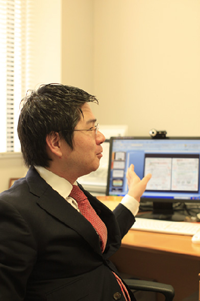 In graduate school my interestsextended beyond end-of-life care to such topics in medical ethics asinformed consent, as well as management of patient safety and adverseevents. After graduate school, I began teaching at the GraduateSchool of Medical Sciences, but I soon found myself involved also inprofessional training for health-care personnel. For example, I madeuse of the university’s extension-course system to pioneer aprofessional development course on management of medical accidentsand issues in clinical ethics. The class, which was held on Saturdaysand Sundays for six months, was designed for a small number (30students), but we received more than 200 enrollment requests eachtime. Enrollees included administrators at major hospitals andmedical school professors. It made me acutely aware that we wereentering a new era. Feeling the need to reward and support those whowere ahead of the curve in their awareness of these issues, and alsoto create a kind of national hub for education and research in thisfield, I teamed with the graduates of my course to found the Societyof Medical Conflict Management in 2005. Today the society has about1,100 members and serves as a base for relevant educational andresearch activity in Japan.
Developing Problem-Solving Skills
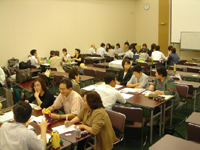 Ever since I began teaching, anotherconcern of mine has been to incorporate innovative teaching methodsto ensure my students acquire not just knowledge but problem-solvingskills as well. For that purpose I have enlisted the cooperation oforganizations outside the university to provide real-worldeducational opportunities. For example, for students in the GraduateSchool of Medical Sciences, we conducted a mock trial of a medicalmalpractice case at an actual courthouse. At Keio, many of myprojects are still in the planning phase, having recently joined thefaculty, but this academic year we held a mock Diet committee meetingand Diet session with the help of the House of CouncillorsSecretariat. At the mock committee meeting, which was held inside theNational Diet Building, members deliberated proposed legislation toamend the Minor Drinking Prohibition Act and the Act on Prohibitionof Smoking by Minors. After the committee had considered thesubstance of the legislation from an ethical and legal standpoint, amock Diet session was held to deliberate and vote on the bill.
Expectations of SFC Students
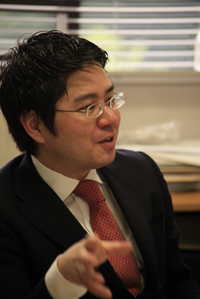 It seems to me that the researchcarried out at SFC demands an integrated, interdisciplinary approach.Much of it is also research of a highly practical nature, for whichintegration with real working environments are of the essence. Forthis reason, I want my students to collaborate actively with peoplein other fields. However, as I explain on my faculty Web page, whentackling topics that demand an integrated, interdisciplinaryapproach, it is all the more vital to have mastered the fundamentalsof the disciplines involved. I want students to realize that whilethose who plan to become practitioners or administrators may tackledifferent topics from those aiming for a career in research, thereshould be no difference in terms of the depth of their study. Ratherthan confine their attention to what goes on inside the university, Iencourage my students to make a point of looking outward to see whatpeople are doing in other academic and nonacademic organizations, inJapan and around the world, so they can build on their own relativestrengths, honestly acknowledge and address their weaknesses, and laythe foundation they will need to become real players farther down theroad. My hope is that they will become front runners and opinionleaders in their chosen fields.
A Brief Background of AssociateProfessor
MAEDA, Shoichi
Associate Professor Maeda completed hisdoctoral studies at the Kyushu University Graduate School of MedicalSciences, earning his Ph.D in medical science. After working as aassistant professor at the Kyushu University Graduate School ofMedical Sciences, he joined the faculty of the University of TokyoGraduate School of Medicine, serving as a project lecturer in theCenter for Biomedical Ethics and Law and project associate professorfor the Department of Patient Safety & Risk Management (duringthis time he also served as deputy director of the Patient Relationsand Clinical Ethics Center at the University Hospital). In 2009 hejoined the Keio University Graduate School of Health Management asassociate professor. His specialties are biomedical ethics (medicallaw, clinical ethics, and research ethics) and medical safetymanagement. He is currently (as of 2010) active on committees withinthe Common Achievement Tests Organization and the Japan Council forQuality Health Care, as well as a number of clinical societies andmedical facilities. His major publications include Byoin rinri iinkaito rinri konsaruteshon (translation of Ethics by Committee: ATextbook on Consultation, Organization, and Education for HospitalEthics Committees) (Tokyo: Keiso Shobo, 2009), which heco-translated; Iryo jiko shoki taio—Sono riron to jissen [InitialManagement of Medical Accidents—Theory and Practice] (Tokyo:Igaku-Shoin, 2008) and Infomudo konsento [Informed Consent] (Tokyo:Igaku-Shoin, 2005), which he edited.
TheSociety of Medical Conflict Management
(12 December 2010)
Archive