
Designing Work
Professor Mitsuyo Hanada has, long,been investigating the concept of work in light of therelational nature of society,organizations, and individuals. He strongly advocates the importance of hands-on work relating the issues. He shared with us his views, drawingfrom the experiences he has gained and practices over last three decades.
HANADA, Mitsuyo
ProfessorFaculty of Policy Management
Real World over Theory
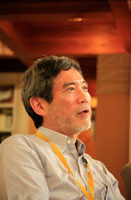 I studied psychology in university.Unlike today, psychology was not a field that attracted many studentsin those days. Keio University’s Department of Psychology where Istudied was a particularly small department, and it was a unique one,too, in that most of my classmates also went on to become educatorsand researchers. During my university years, I mainly looked atpsychological phenomena using the tool of experimental psychology. Ihad always been interested in the fields of social psychology andeducational psychology, and I started to conduct experiments andresearch into how a person’s social backgrounds influences his orher outlook and way of thinking. After graduating with a bachelor’sdegree from Keio, I wanted to study a broader academic field, such aseducational psychology and organizational behavior, and decided tostudy in the United States. Rather than conducting theoretical research, though, I wanted to take a hands-on approach and explorethe actual behavior of individuals.
Learning from Hands-on Work
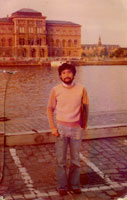 I enrolled at the University ofSouthern California graduate program and earned two master’sdegrees—one in educational psychology and one in sociology—and aPh.D. in sociology. I did not hole up in the lab for my studies,though. I learned about society in real-life settings, and I reallylearned a lot. In the area of pedagogy, for example, I studied schoolcounseling and served as a school psychologist. I was involved insupporting the social integration of students with severedisabilities. I also helped to create frameworks for volunteer-basedcommunity activities. The United States adopts an administrativesystem composed of states, counties, and cities/towns. In veryspecial cases, however, there are communities that choose not toincorporate as cities or towns. In other words, the residents of acommunity can decide not to adopt the administrative structure ofcity or town. In such cases, public services are provided directly bythe county. A variety of problems arise as a result, though, andsupport organizations staffed by volunteers are created to act inplace of the city or town as consultants and intermediaries betweenthe residents and the county. I offered counseling services regardingeducation at one such organization. In the area of organizationalscience and sociology, I conducted research on how to supportcorporations and factories with a multinational, multiethnicworkforce in their efforts to encourage employees to have a sense ofunity and a positive work attitude while allowing each other toretain their unique individuality. While doing this research, I alsoprovided consulting services in related activities at corporationsfacing this challenge.
Putting My Real-World Experience toWork
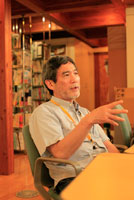 After receiving my graduate degrees, Icontinued my research and hands-on work in the United States. I had agrowing sense, though, that I wanted to look at society from aslightly different perspective. Just at that time, the SANNOInstitute of Management invited me to join them in creating a newkind of university—one with an entirely new structure. I love tocreate new things and I had many ideas percolating in my mind at thattime so I decided to return to Japan to get involved in designingthis new university. It was 1978. While mentoring students at thenewly established SANNO University, I also worked with Japanesecompanies that were entering overseas markets. I was helping themcreate support programs for local employee training. In those days,Japanese companies were just starting to set up local affiliatesoverseas, and very little was known yet about how to manage and trainlocally hired employees, develop their sense of belonging in theorganization, and successfully launch a factory or company. During myyears in the United States, I had had the experience of supportingpeople in various life circumstances. Also around that time,psychology-based corporate management packages had started to beavailable in Japan. I was able to apply my experience and modifythese foreign-made management packages to fit for Japanesecorporations in expanding overseas. I worked closely withcorporations in every aspect of the process, from on-site hiringactivities that required me to make extended stays overseas, toemployee training and team-building as well as the development ofmethods for the corporations to provide ongoing support to their newfactory or company.
Creating Something Entirely New
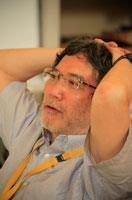 Just when I was sensing that the workwith SANNO University was at a good stopping point for me, I waspresented with an opportunity to participate in the launching of theKeio University Shonan Fujisawa Campus and I decided to take up thechallenge of this new creative adventure. I envisioned and createdclasses where students could learn by participating in society evenafter coming to SFC. I designed classes where, for example, studentscould participate as volunteers or interns at different organizationsand groups. Today such a class that offers students an opportunity towork in a corporate setting would be called an internship. SFC wasnew in those days, though, so when the first and second cohorts wereheading toward graduation we needed to get the word out to society atlarge and particularly to corporate human resource departments aboutthe merits of the kind of students we were producing. In this way, wehoped to support students’ job hunting efforts and careerdevelopment. Every week corporate HR officers were invited to come toSFC and watch a class and see what kind of students our campus wascreating. It is quite hard to raise the name recognition of a newacademic faculty among corporate HR departments, but we worked hardto develop and implement a framework to achieve exactly that. Lookingback on it now, it was a satisfying and enjoyable time.
Career Resource Laboratory
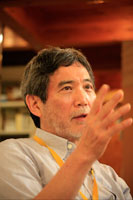 In 1999, I launched the Career ResourceLaboratory as one of the first laboratory at the Keio ResearchInstitute at SFC. The Career Resource Laboratory teams up withcorporations and assists them in creating internal frameworks andprograms to support each employee in autonomously crafting his or herown career. We are not “outside consultants.” We form a singleteam with the company representatives and brainstorm and take actiontogether. To do this, it is crucial that we have a firsthandunderstanding of the perspective of employees in the various workpositions. We also place emphasis on developing trainers so that theprogram takes root and can operate successfully even after we are nolonger involved. There are many, many package programs available, butI think it is the university’s mission to provide support developedby starting from a zero base and considering matters from the on-siteperspective. It is also the university’s responsibility to innovateand create new proposals through an ongoing process of trial anderror.
Moving Forward Constantly
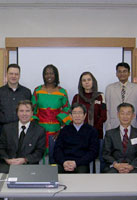 For the past five or six years, I havebeen involved in a Japan International Cooperation Agency programwhere government officials in charge of vocational education and HRtraining officers at major corporations in developing nations andcountries facing industrial development challenges are invited for afew weeks to Japan and together we create career education andvocational education programs. What kind of vocational educationprogram would be suitable for a given nation? What can we do toensure that the education programs and packages are easy tounderstand? We develop educational materials to create a positivework mindset, an attitude where each employee has a sense ofownership for his or her job. We clearly emphasize that work is notjust a question of skills and knowledge, but is also a question ofhaving a positive work attitude. I am confident that this is acritical core principle, true at organizations and corporations inany nation. To build this attitude requires clear principles and asolid vision regarding the content of the vocational and careereducation as well as easy-to-understand educational materials. I amengaged in such activities because I think they are important for abetterment of everyday life in all corners of society.
A Brief Background of Professor
HANADA, Mitsuyo
Professor Hanada received hisbachelor’s degree from the Department of Psychology of KeioUniversity’s Faculty of Letters in 1971 and moved to the UnitedStates that same year. He enrolled at the University of SouthernCalifornia where he received a master’s degree in educationalpsychology in 1974, a master’s degree in sociology in 1976, and aPh.D. with distinction in sociology in 1978. He was a lecturerat the Department of Sociology at California State University, LosAngeles; professor at the School of Management and InformationScience at SANNO University; and later director of the GlobalManagement Research Center at that same university. In 1991, hejoined the Faculty of Policy Management at Keio University asprofessor. Today he heads the Career Resource Laboratory, part of theKeio Research Institute at SFC. Professor Hanada specializes in humanresource and career development and is involved in research andhands-on work in a wide range of areas, including international HRmanagement systems and the design of new HR organizational paradigms.His major journal articles include “Jinji seido ni okeru kyosogenri no jittai” [The Principle of Competition in Human ResourceManagement Systems] (winner of the Fiscal 1987 Takamiya Award formost outstanding article from the Academic Association forOrganizational Science; Organizational Science, 1987),“Implementation of Human Resource Management Systems Based uponIndividual Career Goals” (Hitotsubashi Business Review, 1989), and“Koa jinzai no kino to joken” [Core Human Resources: TheirFunctions and Conditions] (Diamond Harvard Business Review, 1995).
(23 November 2010)
Archive