
Toward a Richly Interconnected World
We spoke with Professor Ikuyo Kaneko,whose work engages with society across a wide spectrum ofconcerns,including new models of volunteering,proposals for theschool and education systems,and the creation of a community-basedsociety which melds the real world and cyberspace.
KANEKO, Ikuyo
ProfessorGraduate School of Media and Governance
My Introduction to Administrative
Engineering and Operations Research
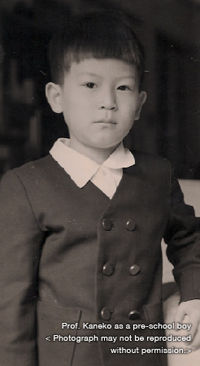 At Keio Yochisha Elementary School, Iwas a quizzical child who liked to puzzle over things like “What’sone divided by zero?” I rediscovered my interest in math atuniversity, where I entered the Department of AdministrationEngineering. That led me to the doctoral program at Stanford to studyoperations research, which is part of the “new mathematics” thatemerged in the 1970s. The old math was based on proving the existenceof a solution; the new math actually computes solutions. A milestonein theoretical economics using operations research was reached whenKenneth Arrow, Herbert Scarf, and others proved the existence of the“equilibrium price” postulated by Adam Smith and his descendants,the neoclassical market economists, by performing actual computationsusing game theory and the fixed point theorem. In other words, theadvent of computers changed the way we formulate our thinking. Peoplelike Arrow and Scarf are heroes to me, because the new math made itpossible to obtain answers that are of practical use in economics andbusiness management. That’s what operations research is all about.To me the attraction of mathematics was that you were free to createa world where you can decide everything yourself, as if you werewriting a novel, and I was excited by the prospect of that actuallyresulting in something useful to society.
The Fascination of Real-World Events
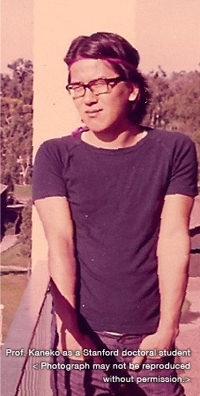 An example of the kind of work I did while learning operations research at Stanford was a computationalstudy of the shipping system of a big U.S. cookie manufacturer. Thismeant finding the fastest and cheapest routes to deliver cookies fromthree factories to several dozen wholesalers and then to severalthousand retailers, and to do so in a timely way based on demandpredictions. In another example, I had to build a mathematical modeland devise a calculation method to determine a safe and efficientroute for laying an undersea cable between Sicily and the NorthAfrican coast; in another, I did structural calculations for thecover of a jet cockpit to improve its wind pressure resistance. I wasdoing operations research with applications in a wide range offields. I continued this work while teaching for nine years at theUniversity of Wisconsin-Madison, and during this time I became awareof a gap between the results I was obtaining mathematically and thereal world. The results of calculations are not applied in their pureform in the real-world fields. What happens in a field is complex. Ithought, “Real-world events often are uncertain, even nonsensical,but that’s what makes them fascinating.” That was one reason whymy interest shifted from working things out inside a computer to howthis relates to the real world and real people. Also, I received anoffer from the Faculty of Commerce and Management at HitotsubashiUniversity right around that time, and so I decided to return toJapan.
Gaining a First-Hand Understanding ofSocial Networks
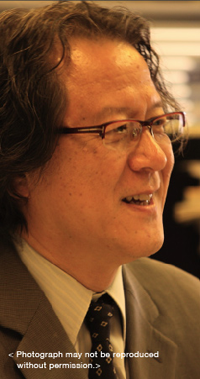 While teaching probability theory andother subjects in the Faculty of Commerce at Hitotsubashi, I studiedrelationship formation processes at the personal and social levels,with “networks” as the key. At Hitotsubashi, I got to know theeconomist Kenichi Imai, who taught me a lot about economics, and Ibecame interested in the concept of the “network society,” anarea in which Prof. Imai did groundbreaking work. I traveled all overJapan to meet people experimenting with new business ventures thatdrew on personal and telecommunications networks. They were doingwhat would now be called “social innovation.” Take the “Pharma”drugstore chain, for instance: small independent pharmacies, barely afew meters across, were able to hold their own with major stores interms of product lineup by sharing information on their best-sellingproducts over a communications network. I was also volunteering oncea week as a telephone counselor for foreign travelers and residentsgetting into some kind of trouble in Japan, and this experienceshowed me that social marginality can give rise to connectivity inmany unexpected ways. I sensed intuitively that the processes thatlead to the creation of new information in this way are the essenceof “networks.” Around this time I wrote the book Borantia: mōhitotsu no jōhō shakai (Volunteers: another information society;Tokyo: Iwanami Shoten, 1992).
To Be Useful, Information Needs to BeSeen
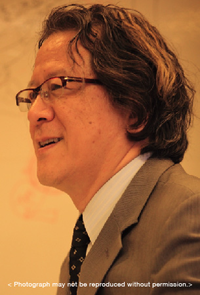 In 1994, I moved from HitotsubashiUniversity to the Graduate School of Media and Governance at KeioUniversity’s Shonan Fujisawa Campus. Then in January 1995, theGreat Hanshin Earthquake hit the Kobe area. Although there were nomedia reports about volunteers immediately after the earthquake, Iwas sure they must be swinging into action, and I went to thestricken areas myself. There I found volunteers pouring in from allover the country. But although there was a pool of well-meaningvolunteers and donated goods, neither materials nor personnel weregetting to the places where they were really needed at the righttime. As the Internet was not yet widely used then, messages aboutwhat was needed where were being posted mainly on proprietary PCnetworks, which were proprietary and therefore closed to othernetworks. There were three major service providers, and so volunteersat the emergency shelters were using three separate accounts for thethree major PC networks, hoping to get access to as many people aspossible, to post information such as “we’re short of this, weneed volunteers here,” then searching for replies on three separatebulletin board systems—a very inefficient approach.
For me, it was a good lesson to know that to be useful, information needs to beshared. I quickly put together a group, and with the cooperation ofthe three commercial network service providers we launched a networkplatform, “InterVnet,” which used the functions of the Internet“news” to make the information from all three systems accessibleon a single bulletin board, as well as on the three separate BBSs.Through InterVnet a user of any of the three major proprietarynetworks would be able to post a message to, or to read a messagefrom any of the three BBS. When this proved effective in supportingthe earthquake victims, it brought home to me the power of networks.
Expanding the Potential of Networks
 My experiences after the earthquake ledto a major refocusing of my research. Starting while I was atHitotsubashi University, I had been gradually moving away frommathematics as such to work more on society and organizations, andhaving created a tool that was of practical use in the fieldencouraged me to focus on “social networks” rather thantechnology networks. The InterVnet utilized the latest technology,but rather than a technical breakthrough, it represented a new formof social organization. At the risk of blowing my own trumpet, theInterVnet was a “social innovation” of the kind that I now teachat SFC to freshmen students. The most socially influential example ofsocial innovation I have worked on since then is the “communityschool,” which is now one of the central issues of the government’seducation policy. I proposed this idea at the National Commission onEducational Reform in 2000. It is a system that involves localresidents and parents in the running of a school, replacing the oldmodel of public schools imposed from above with a partnership betweenschool and community working together to create the school theyconsider best. Because authority is decentralized, these communityschools can be run in a way that reflects a broad spectrum of localneeds and opinions, and all parties can have a strong sense ofinvolvement. I should mention that in conceptualizing the communityschool and eventually getting it passed into law, I worked with KanSuzuki, who was then on the SFC faculty and is now Senior ViceMinister of Education, Culture, Sports, Science and Technology. Thereare currently more than 600 community schools all over Japan.
Connecting with Society
 As far as my university research goes,at present I am mainly engaged in a project called “Green SocietyICT Life Infrastructure.” In order to create a society that cancope with the impact of climate change, this project works at thelocal community level to realize an energy-efficient and secureliving environment by means of interconnected energy managementsystems (= ICT Life Infrastructure) that gather, analyze, and respondto information directly relevant to our daily lives. Theinfrastructure consists of a comprehensive energy management systemthat includes natural energy from solar power, biomass among others,together with systems in such areas as health and medical care,agriculture, and disaster preparedness. For example, we haveintroduced systems that allow elderly people living alone to havetheir health status monitored around the clock by wearingstate-of-the-art micro sensors and to enjoy the convenience oftelemedicine consultations. We are working with Keio Universityresearchers in specialties that range across the Faculty of PolicyManagement, the Faculty of Environment and Information Studies, theGraduate School of Media and Governance, the Faculty of Science andTechnology, the School of Medicine, and the Faculty of Business andCommerce, among others, and with two local governments and fivebusiness corporations. Undergraduate and graduate students will alsobe involved. I intend to continue collaborating with students andfellow researchers to pursue a variety of challenges in the future.
A Brief Background of Professor
KANEKO, Ikuyo
Professor Kaneko received hisbachelor’s degree in 1971 from the Department of AdministrationEngineering, Faculty of Engineering (today’s Faculty of Science andTechnology), Keio University. In 1972 he went to the United States,where he earned a master’s degree in 1973 and a doctorate inoperations research in 1975 from Stanford University. After servingas assistant professor and associate professor in the Departments ofIndustrial Engineering and Computer Sciences at the University ofWisconsin-Madison, he was appointed associate professor and thenprofessor in the Faculty of Commerce and Management, HitotsubashiUniversity. In 1994, he joined Keio University’s Graduate School ofMedia and Governance (GSMG) as professor, later concurrently servingas head of the Keio Yochisha Elementary School and then as Dean ofGSMG; he is currently Executive Director of the Keio ResearchInstitute at SFC. He specializes in network theory, community theory,and social innovation. His major publications include Borantia(Volunteers), Komyuniti soryūshon (Community solutions), and Nihonde “ichiban ii” gakkō (The “best” school in Japan), allpublished by Iwanami Shoten, and, as co-author, Borantarī keizai notanjō (The birth of the Voluntary Economy) published by Jitsugyō noNihon Sha.
(11 October 2010)
Archive