
Working with Computers to Create a New Paradigm for Architecture and Urban Landscapes
Working with Computers to Create a New Paradigm for Architecture and Urban Landscapes
Professor Yasushi Ikeda believes thatwhen it comes to architectural design, computers can be much morethan tools—they can actually expand the range of possibilities and suggest new paths to follow. We talked with Professor Ikeda about his vision for architectural design generated through the terplay of computer technology and human creativity.
IKEDA, Yasushi
ProfessorGraduate School of Media and Governance
Encouragement of Architectural Learning
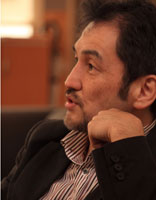 From the time I was a small child Iloved to draw. I was in elementary school when Osaka Expo ’70opened, and I was so inspired by its futuristic vision of the humanliving environment that drawing imaginary cityscapes became mypassion. I decided to major in architecture at the encouragement ofmy high school art teacher. At a time when I was finding it hard tosettle on an academic and career path, he told me, “If you likedrawing pictures of cities, the department of architecture would bethe best place for you to learn about the urban environment and itsarchitecture from an engineering standpoint.” Everyone experiencescertain life-changing encounters, and that day I experienced mine. Onthe very same day my teacher gave me that advice, I went to thelibrary and stumbled on a book illustrating the work of Frank LloydWright and Minoru Yamasaki, the Japanese American architect whodesigned the former twin towers of the World Trade Center. I took thebook out, and as I looked through it, it became clear to me that thiswas the path I was meant to follow. By the time I applied forcollege, I knew for certain that I wanted to major in architecture.
Viewing Architecture in the Context ofUrban Landscapes
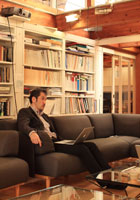 In college, I was determined to studyunder Professor Fumihiko Maki, who was already a superstar in theworld of architecture. I entered his laboratory, and in fact ended upstudying with him for about nine years altogether, including graduateschool and the time I spent working in his design office. ProfessorMaki became my master and mentor in the field. My goal when I begancollege had been to learn how to design a building, but in the MakiLab, the focus was not so much on individual buildings as on theurban space as a whole. Instead of treating architecture inisolation, Professor Maki was advocating a broader approach thatremoves the distinction between individual structures and the urbanspace they collectively form. He felt there was more to be learned bystudying the urban systems that spring up naturally in a community,without anyone consciously creating them, than by focusing narrowlyon the works of specific architects. For my undergraduate Bachelor’sProject, I drew up my own development plan for Tokyo’s Shiodomedistrict, which is now undergoing redevelopment. In graduate school,one of my research projects involved taking photos of the urbanlandscape, loading them onto a computer, and analyzing the underlyingrules and principles informing those townscapes.
Computers and Architecture ComeTogether
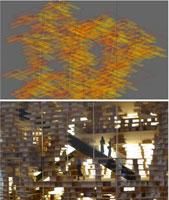 In my second year of graduate school, Ihad the opportunity to assist in the preparation of Professor Maki’ssuccessful entry for the Makuhari Messe design competition. Becausethe structures Professor Maki’s team envisioned for the conventioncenter used a huge number of trusses, drawing the plans by hand poseda daunting challenge. I wondered if a computer couldn’t be used torender the trusses. At that time, computer-aided design (CAD) systemswere virtually nonexistent, so I did my own programming and used itto complete the drawings. From there, I began to contemplate thepossibilities for architecture designed with the aid of computers,and that train of thought led eventually to the idea of algorithmicdesign, which even today remains a key concept in my research.Researchers in the field of algorithmic design are making the mostnot only of human skills but also of what computers have to offer. Weare exploring the new possibilities that open up when computersbecome the basic platform for architectural design instead of thearchitectural drawings that have always performed that function.
Computers as a Source of Insight
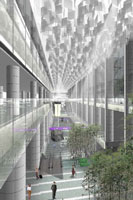 Overseas, what we call algorithmicdesign is commonly referred to as parametric design. The reason weadopted the term algorithmic design instead is that we want to conveyour own unique approach. Parametric design still carries the nuanceof computers as nothing more than tools for the execution of humanideas. Our idea was to go beyond that and try to make computers dohalf of the “thinking,” so to speak. We believed that by enablingcomputers to “think,” we could have them point the way to newpossibilities that had never occurred to people, and that was therole we wanted them to play. If we can simulate our existingperceptions on a computer, we can also reverse the process and usethat capability for other purposes, to do things we never did before.As I see it, the possibilities suggested by the results of variouscomputer simulations can change our basic perception of form-making.Moreover, by their very nature, computers can come up with ideas thatare unbound by the constraints of convention. Whenever human beingsapply themselves to a familiar problem, they automatically restrictthemselves to a narrow range of solutions. For example, when layingout windows in an architectural drawing, we instinctively stay withinan established range of possibilities instead of starting from theidea that windows can take any number of forms.
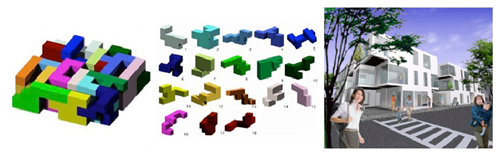 Computers can generate simulations of plans that are more complex than anything ahuman being can draw. They can serve as the bridge between new ideasand the actual feasibility of those ideas. In all of these ways,computer programming has made it technically possible to do thingsthat we human beings were unable to do by ourselves. Rather thansimply ask how technology can help us execute what we already have inmind, we want to focus more on drawing inspiration from the newpossibilities offered by technology as we consider what sorts ofdesigns to tackle next.
Expanding Horizons at SFC
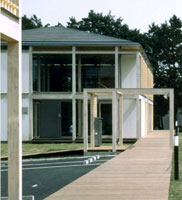 I used computers in the practice ofarchitectural design before coming to the Shonan Fujisawa Campus, butafter coming here I began to consider the relationship betweencomputers and architecture/urban space in a context separate fromdesign practice. With the development and spread of computer andnetwork technology over the past dozen years or so, our socialsystems have changed by leaps and bounds. Unfortunately, the designof our urban environment has not changed as dramatically as one mighthope. To some degree, people in the design industry have resisted therise of virtual space and remained centered on conventional methods.I think the reason is that, while computers have expanded ourthinking, there was some uncertainty as to what people could actuallydo with this enhanced three-dimensional view computers have given us.But I am convinced that all this will change in the years ahead, asour algorithmic design methods are linked up with thecomputer-controlled industrial technology known as “digitalfabrication.”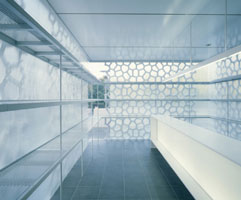
Then our methods will evolve into a real industrialtechnology that uses IT to create spaces “intelligently,”allowing us to shift from the twentieth-century model of architectureand urban design, which is predicated on mass-production andmass-energy consumption, to a whole new kind of value in urban andarchitectural design. It seems to me that I only began thinking insuch terms after I entered into a situation where my perspective isconstantly alternating between that of an architect who createsactual structures and that of a teacher-researcher. At SFC,instructors and students with a great diversity of ideas andapproaches come together to create an atmosphere that I findextraordinarily stimulating. Here one learns about cutting-edgetechnology, all the while working closely with real objects, realcreations, the real world. As I see it, discovering new possibilitiesin that interaction is what SFC is all about. And I am committed toincorporating this unique strength into the work we do in my ownlaboratory.
A Brief Background of Professor
IKEDA, Yasushi
Professor Ikeda graduated from theDepartment of Architecture of the University of Tokyo’s Faculty ofEngineering in 1985. He went on to complete the master’s program inthe Graduate School of Engineering and earn his Ph.D. in engineering.He joined Maki and Associates in 1987 and worked there until 1995,when he left to establish the Yasushi Ikeda Design Studio (renamedIkeda Kokubun Design Studio, or IKDS, in 2003). After teaching forseveral years at the Keio University Faculty of Policy Management asassociate professor(non-tenured)andin other positions, he was appointed associate professor at theFaculty of Environmental Information in 1999, and became professor in2008. Professor Ikeda’s specialty is architecture and urban design.His major projects include the Multimedia Conference Room, KeioUniversity SFC (1999); Design Studio Buildings, Keio University SFC(2000); Institute for Advanced Biosciences, Keio University (2001);New Main Building, Keio Futsubu School (2001); Daizawa Plus Co-op(2005); plan for an apartment complex in Binjiang, Quanzhou (2005);Sakata City Community Service Seminar Center Multipurpose Hall(2006); and plan for an airport rapid transit system station, TaipeiMain Station redevelopment project (2006). His publications includeVijuaru ban kenchiku nyumon 5: Kenchiku no gengo (Visual introductionto architecture 5: The language of architecture) (Tokyo: Shokokusha,2002), to which he contributed a chapter.
IkedaKokubun Design Studio (in Japanese)
(23 August 2010)
Archive