
Transforming the Landscape of the World with Database
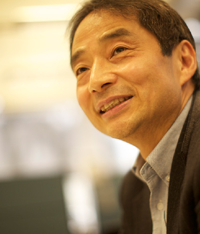
Professor Yasushi Kiyoki has alwayswanted to create an intelligent world through the database. Today heis developing the power of the database to support society in realways. We spoke to Professor Kiyoki about what a database does andwhat roles it can play in the future. He showed us what he was doingand in the process we realized that his research wasblazing a trail of innovation and discover.
KIYOKI, Yasushi
ProfessorFaculty of Environment and Information Studies
Mapping the Real World
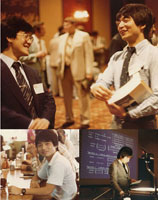 I first heard about the database in1977 when I was an undergraduate student at the Faculty ofEngineering, Keio University. I was doing graduation work and hadjoined the lab of Professor Hideo Aiso, who later became the firstdean of the Faculty of Environmental Information. The foundation forthe current database technology had just been proposed in a paperpublished in 1970. In those days, database technology was still inits infancy compared to other fields of computer technology. However,Professor Aiso and the other members of his lab were convinced thatdatabase would be a very important computer science technology in thenear future. Since there was not much information available at thetime, we had to go to great length to collect any research work orpapers written on it from around the world. We set up a readingcircle and met almost every day.Database research looks at thequestion of how to map what happens in the real world as a recordwithin the framework of the information system. Of the various kindsof research linking computers and society, database research isclosely connected to the real world. I became more interested inlooking at how computer science could be closely tied to society.
Selecting Information Based on Context
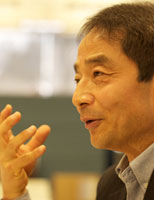 People use database systems all thetime. Database corresponds to the memory system in the human brain,particularly its function of memory and recall. Database researchdetermines the best way to design computers that can perform suchfunctions.As I investigated this subject, I discovered that there wasa vast difference between the memory system of human beings andcomputers. The memory system of human beings has an extraordinaryretrieval process; the retrieved meaning differs depending on contextand situation. For example, let us take the word “green.” If yousearch for “green” in a regular database, it will only pull updata that contains the keyword “green.” This is also true forsearch engine such as Google. On the other hand, human beingsassociate “green” with a range of meanings. If they hear the wordat a traffic intersection, they think of a green light and assign itthe meaning “go ahead.” If they hear the word when they are athome feeling under weather, they may interpret “green” as“feeling ill.” In the memory retrieval process, the human braintakes into account both context and situation and therefore peoplecan retrieve different meanings for the same word.
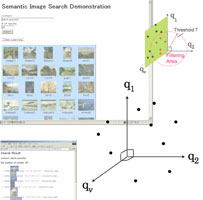 Databases wereinitially created on the principle that one word had one meaning, butI wondered if a database could be developed on the basis of anunlimited number of meanings for a single word. I changed the goal tocreate a database that determines the meaning after situation andcontext are given.The Longman English dictionary has about 60,000entries for which it creates definitions using about 2,000 Englishwords. I took that and created a vector space of about 2,000dimensions and positioned objects, such as words, images and music inthat space. To visualize it, think of outer space and the myriad ofstars there. If you pick out two objects in that space, the distancebetween them can be calculated and data can be selected by assessingthe relationship of objects based on distance. We can determine therelationship not just between words, but also between music, betweenimages, and the like by calculating the distance between them. Thisconcept was entirely new at that time. I named the system the“mathematical model of meaning” and published my first paper onthe topic in 1993. This continues to be the base of my researchtoday.
Looking for Ways That Database
Can Serve Society
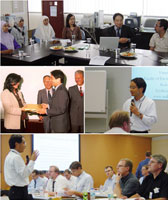 The study of database does not end withan investigation into foundational systems alone. How to apply thetechnology in the real world is a key issue. I came to the ShonanFujisawa Campus just at the time when I was particularly concernedabout this aspect of database. The year was 1996 and I was juststarting to develop real-world applications based on my technicalskills. I thought the timing was right to move to SFC where labs invarious academic areas engaged with one another as partners insociety. In fact, my lab does have frequent interaction with otherSFC labs. Today we are collaborating on a project with the lab ofProfessor Hideyuki Tokuda, which is researching ubiquitoustechnology, and that of Associate Professor Ikumi Waragai, whichspecializes in German language and culture. Our joint project aims tomap German study aids throughout SFC and create an environment wherestudents can obtain the study aids through mobile devices if they arenear one of the mapped points. In another project—this withProfessor Atsushi Okuda’s lab—we are attempting to create adatabase on the concept of space for the Islamic world’s Qur’an.
Expanding the Potential of Database
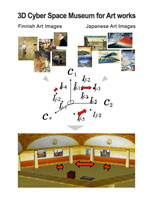 My lab not only does research withother SFC labs, but also engages in joint projects with industry andgovernment. Together with East Japan Railway Company, my lab isdeveloping data distribution technology tailored to facilities andservices related to railways. People at train stations during themorning rush hour and those at the stations in the middle of the dayhave different lifestyles and interests. Today most of theinformation for distribution is selected by the senders only based ontheir intuition of what people might want. It is hard to imagine thatthis method is really effective. Databases tell you what informationwould be most effective at which time and at what place and makeeffective data distribution possible. We are also involved in thiskind of research on digital signage.My lab is also engaged in the area of international exchange. International exchange has been basedon language, and interchange with people who speak a differentlanguage has not been possible unless one side learns the other’slanguage. In a global world, it is very important that people havecontact with those from other countries and regions from childhood.However, Japan does not yet have that kind of environment. We are nowdeveloping a system for people to enjoy exchange with all kinds ofpeople not using language, but using pictures and music.
  We arecreating a system where people can share their “Kansei”―sensitiverecognition, such as human senses, feelings, sensitivity, andpsychological and physiological reactions―with people in thecountry or region with which they want to have exchange. People cancollect and share pictures and music on the same theme, for example,the season of spring. This system enables people to share suchinformation with each other without knowing each other’s language.This is just one of the projects we are undertaking to expand thepotential of databases.
Creating an Intelligent Society
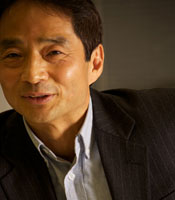 The communication functions built intomobile phones and personal computers are quite advanced today, butthere are still many issues to resolve before we will be able tofully satisfy our intellectual curiosity by accessing advancedknowledge in our day-to-day lives. Many people enjoy text messagingwith their mobile phones, but they cannot yet access knowledgebases.Database technology is not the only form of intelligence, butit is not possible to create an intelligent society based oncommunication alone. Databases can play an important role in creatingan environment for people to think deeply and conceive new ideas. Tothis end, I aim to spread databases and knowledge bases throughoutsociety. My dream is to use database technology to create anenvironment that completely transforms the landscape of the world.That would be just amazing.
A Brief Background of Professor
KIYOKI, Yasushi
Professor Kiyoki received hisbachelor’s degree in electrical engineering from the KeioUniversity Faculty of Engineering in 1978. He went on to complete themaster’s and doctoral courses in engineering at the same universityand was awarded a Ph.D. in engineering. In 1983 he joined theMusashino Electrical Communication Laboratory of Nippon Telegraph andTelephone Public Corporation. In 1984, he became assistant professorat the University of Tsukuba’s Institute of Information Sciencesand Electronics, and was promoted to associate professor in 1988.After working at the University of California at Irvine, and theUniversity of Texas at Austin (sponsored by the then Ministry ofEducation’s fellowship program for Japanese scholars andresearchers to study abroad), he became associate professor at theFaculty of Environmental Information in 1996 and professor in 1998.His specialties include multimedia databases, kansei databases,multidatabase systems, and semantic associative searches.MajorPublications and Papers: Yasushi Kiyoki, Xing Chen, and HidehiroOhashi, “A Semantic Spectrum Analyzer for Realizing SemanticLearning in a Semantic Associative Search Space,” InformationModelling and Knowledge Bases 17 (May 2006): 50–67. Yasushi Kiyoki,Yoshifumi Kaneko, and Takashi Kitagawa, “A Semantic Search Methodand Its Learning Mechanism for Image Databases Based on aMathematical Model of Meaning,” The Transactions of the Instituteof Electronics, Information and Communication Engineers J79-D-II, No.4 (April 1996): 509–519.
(16 July 2010)
Archive