
A New Perspective Through Learning a Language
Associate Professor Ikumi Waragaibrings a multifaceted approach to her research on German literature.We talked with her about the significance of gaining a newperspective through language studies and about the language teachingprojects she is now engaged in through collaboration that is uniqueto Keio University Shonan Fujisawa Campus.
WARAGAI, Ikumi
Associate ProfessorFaculty of Policy Management
Music and German Studies
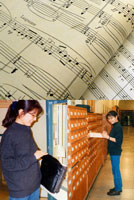 I have loved opera since my teens and Iused to sing my favorite arias without knowing what the words meant.I also played in the brass band at junior high school. Herbert vonKarajan was then at the height of his career in Germany. This was thereason for me to learn German. My interest in German literature grewduring my study at the Catholic high school. I decided to studyGerman literature at Nanzan University where they were offering thiscourse. After developing my language skills I began to study theaterand fiction focusing on German feminist writers. Then I went to theUniversity of Bonn and acquired MA and Ph.D. at the Department ofGerman Literature, the Faculty of Arts. My doctoral dissertationinvolved a functional analysis of Christian elements in some literaryworks. The analysis of literary works from this perspective broughtsome interesting hitherto unknown facets of literature into light. Iam still involved with opera. Three years ago, I was commissioned towrite a Japanese libretto for a German opera in Japanese. Thislibretto was written by the great composer Hans Werner Henze andbased on Yukio Mishima’s novel, Gogo no eiko (The Sailor Who Fellfrom Grace with the Sea). After its world premier in Japan, the operawas staged at the Salzburg Festival, becoming the firstJapanese-language opera ever performed at the festival. Now I aminvolved in creating the Japanese supertitles and TV subtitles forvarious operas.
Encountering the German ReligiousCommunity
 While studying in Germany, I wassurprised to find that the image of religion there was quitedifferent from that in Japan. In Germany foreign students are oftenasked about their religious commitment. Students from Japan oftenconfess that they have no religious commitment. The Germans are quitesurprised by their answer as it amounts to rejecting the community orinsulating themselves from it. In Germany church-run hospitals,schools, and kindergartens are ubiquitous and therefore not belongingto a church implies living without the help of the community. Inother words, in Germany it is normal to belong to a religiouscommunity. Religion is a community, a living model and one’s way oflife. I think most Japanese will agree that this concept is quitedifferent from ours. I am not suggesting that everyone should havereligious affiliation or subscribe to a particular faith. However, Ido think that it is important to appreciate other ways of thinking.It is also imperative to know the social structure of other countriesin order to function effectively in diverse cultural and religiousmilieu.
Religion Background in Literature
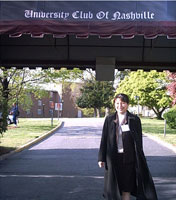 Comprehending the religious aspects inwork of art, such as literary composition, musical work or paintinghelps us to understand them better. For example the German verbeinsinken means “to sink into” or “to cave in”. However, italso connotes a Christian meaning that is “to become immersed inGod”. Understanding the connotation of a word helps us to gain newinsights into literature. I believe that western literary history isdeeply rooted in the Protestant religious ethos. The study ofliterature as an academic discipline dates from the EuropeanEnlightenment. The Enlightenment thinking underscored the idea ofpursuit of truth as the only way to understanding God. And thisperspective is clearly reflected in the systematic approach ofliterary history. I also believe that what was later imported inJapan as the canon of Western literature was shaped precisely by theview of literature developed during the Enlightenment. How did theJapanese receive Western literary works that had a strong religiouscomponent? Were these religious elements recast in other forms whenthey came to Japan? I think that it is important to examine questionsto gain a new perspective about literature.
The Prism of Language
 The meaning of a text changes dependingon the language, and the recipient gleans completely differentinformation. For instance, a Japanese news text will acquiredifferent meanings if the translated subtext is in German or English.We in Japan receive most of our information from different parts ofthe world in English. Thus, when news from non-Anglophone Europeancountries reaches Japan in English the information has already passedthrough an Anglophone filter. In other words language alters ourperspective. I want students to understand the culture, language andreligious background of the countries when they learn language. Ialso feel that just to master the English language is not enough.Knowing a language other than English or our native language whichframes things in a different way may help us to interpret informationin relative terms. Students should not be satisfied with obtainingjust conventional linguistic skills. They should broaden theirhorizons and gain multiple perspectives through other languages aswell.
Toward a Personalized Learning
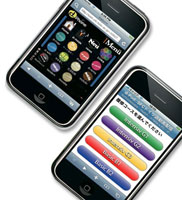 I am also involved in developing Germanlanguage teaching material through joint research. My goal inteaching German to students is to help them go beyond the rudimentaryaspects of speaking the language where they just introduce themselvesand describe their interests. I would like them to think in Germanjust as they do in Japanese. Since the acquisition of practicalskills through conventional rote method may be difficult, I amdeveloping new strategies. Ideally, learners should be exposed to thelanguage beyond the classroom setting and within their ownenvironment. Thus, I am now developing language materials inconsonance with the evolving social environment. Recently, mylaboratory collaborated with another laboratory to create a Germanlearning environment and linguistic text through the use of mobiledevices such as iPhones. I believe that people differ in their choiceof study methods just as varied as they do in food taste. I want tocreate a learning environment and language material that can becustomized by students to suit their learning style.
Unique Joint Research at SFC
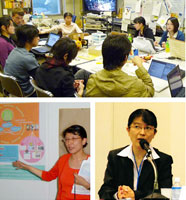 The Seminar pursuing this work is knownas Projekt “Neue Medien und DaF” (or Project New Media and Germanas a Foreign Language). It is a joint project between my laboratoryand that of Visiting Assistant Professor Marco Raindl. The membersinclude undergraduate and graduate students and researchers. Some ofthe students have had experience in Germany on short- or long-termstudy programs or have conducted fieldwork there. Conducting jointresearch with a German professor and students helps us to developlearning materials from the learner’s point of view. One of ourcurrent projects uses GPS to create a learning environment. Forexample, if a student is at a restaurant in Germany and his/hermobile terminal is detected by GPS, his/her terminal automaticallydownloads a video podcast showing how to order from the restaurant’smenu and how to tip the waiter. We have already run a number oftrials of this mode.This semester, we plan to try refining the GPSaccuracy using the Campus Network System, so that the system can helpus create a customized podcast to be delivered when a student is,
for example, in front of the statue of Yukichi Fukuzawa, or beside theGulliver Pond at SFC. In our conceptualization the faculty andstudents are not divided into teacher and taught. They are all in theproject team together. In this relationship, we are working on thenext generation of language teaching materials with the laboratoriesof Professor Hideyuki Tokuda, in ubiquitous network research, andProfessor Yasushi Kiyoki, in multimedia database research. One of myformer students of German language, now research associate, ShuichiKurabayashi, is also working with us on a language database. When Ihave the opportunity to talk to fellow specialists in Germanliterature or German language pedagogy from other universities, manyof them are astonished by the kind of research we are doing. Anenvironment like this, where we can collaborate and create somethingwith people belonging to laboratories in other research fields, isquite rare. I am quite aware of how productive it is to work withexperts in such diverse fields, and how this interaction can help usto broaden our potential. I also think this kind of research providesan ideal learning situation to our students. It is the uniqueenvironment of SFC that makes all this possible.
A Brief Background of AssociateProfessor
WARAGAI, Ikumi
Associate Professor Waragai graduatedin 1987 from the Faculty of Literature, Nanzan University. She earnedher M.A. in 1989 and her Ph.D. in German Literature in 1995, bothfrom the University of Bonn. After serving as a part-time instructorat Keio Girls Senior High School and a Research Assistant in theFaculty of Policy Management, Keio University, she was appointedAssociate Professor in the same Faculty in 1999. Her areas ofspecialization are German language and literature and German languagepedagogy.She has published Analogien zur Bibel im Werk Büchners:Religiöse Sprache als sozialkritisches Instrument (Biblicalanalogies in Büchner: Religious language as an instrument of socialcriticism) (Frankfurt: Peter Lang Verlag, 1996). She has co-authoredBibelsprachliche Wortschätze (Lexicology of the Bible) (Berlin:Walter de Gruyter Verlag, 2002), Shokyu Doitsugo (German forbeginners) (Tokyo: Daisan Shobo, 2001) and Moderu (1) Mondai hakkenno Doitsugo (Modelle 1: German through problem identification)(Tokyo: Sanshusha Publishing, 2007). In 2000, she translated thesupertitles for a performance of Manfred Gurlitt’s opera Wozzeck,which won the Agency for Cultural Affair’s National Arts FestivalExcellence Award. In 2005, she participated as supervisor in aproject commissioned by the Yomiuri Nippon Symphony Orchestra andtranslated the Gottfried Benn poem on which Toshiro Saruya based hiscomposition Koko ni nagusame wa nai (or There is no consolation). In2006, Saruya won the 54th Otaka Prize for his composition. She alsowrote the Japanese libretto for the opera Gogo no eiko (The SailorWho Fell from Grace with the Sea), which was staged at the SalzburgFestival Hall in 2006, becoming the first opera performed in Japanesein the history of the Salzburg Festival.
(29 March 2010)
Archive