
Attempt to Measure the Immeasurable: Expanding the Frontiers of Sports
Sports engineering has traditionallyfocused on the analysis of video images, but Associate Professor YujiOhgi has been looking at this field from the perspective ofmeasurement. Driven by the desire to spread the joy of sports, he hasdescribed how the potential of sports is expanding as thingspreviously considered impossible to measure are now being measured.
OHGI, Yuji
Associate ProfessorGraduate School of Mediaand Governance
From an athlete to a researcher
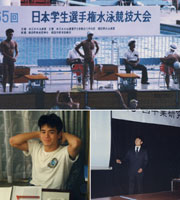 I first started swimming when I joinedthe junior high school swimming club. Swimming is mainly anindividual sport. This meant that if a swimmer practiced harderhe/she could swim faster. I felt quite motivated by this mechanism ofindividual sport and quickly became committed to swimming. As myeffort at swimming increased, I often swam for six hours a day. LaterI even participated in the Japanese Olympic trials.When the time cameto enter university, I selected the University of Tsukuba, whichpossessed a good swimming environment that could help me to continueswimming. In the master’s program at the university, I continuedswimming while studying for coaching. Those athletes who pursuecompetitive sports during their university education get into manydifferent fields. Those who think that research in physiology isimportant join a physiology lab while those who think that studyingmental aspect of athletes is important enter a psychology lab. I wasinterested in conducting research on how to swim faster from theperspective of biomechanics. As such I joined a sports biomechanicslab from my undergraduate days. Since then I have continued myresearch in the field. I have always enjoyed creating electronicdevices and software. I have really enjoyed conducting researchitself. If I were not doing research at SFC, I would definitely bedoing something similar.
Precise data in real time
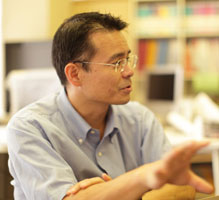 In the area of sports engineeringresearch, researchers often film athletes in motion and then analyzethe images. However, swimming presents some unique challenges. It isimpossible to get a clear image in water due to bubbles and splashesthat the swimmer creates while moving in water. The other problemwith filming athletes, swimmers and other sportspersons is that itrequires filming of a large area according to their fast movement.This means that the athlete inevitably ends up being small in theimage. Enlarging the picture results in low resolution makesdifficult to analyze the subtle movements of the athlete. As a resulterrors may occur. My lab developed a small, lightweight sensor thatathletes can attach to themselves. Instead of filming the athlete, wemeasure the movements of the athlete with the sensor. This way we canacquire precise data on the athlete in motion.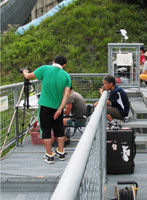
Recently, I had ski jumpers wear such sensors. The data on their movements while theywere still in the air and data on air resistance they experiencedwere sent wirelessly to us on the ground. In the future, I hope tosend such information as digital broadcast content, close to the realtime. If those people watching the sports program on their livingroom TV know that the skier they are watching has taken off too fastor that he/she lost speed because of headwinds, it can make sportsmore interesting.Having data in real time would also help withcoaching athletes. For instance, a coach cannot give advice to theathlete in real time based on the image because the athlete cannotwatch his/her image in motion. That is the reason why we are lookinginto using sound. In collaboration with Professor Masaki Suwa and hislab at SFC that conducts research on cognitive science, we havestarted researching on delivering the information as sound. Forexample, we could convert movements into sound to let the athleteknow about his/her swing of the baseball bat or tennis racket. Thesound given when the form is correct would differ from the soundgiven when it is incorrect. This would let the athlete know thathis/her form is incorrect so that he/she could then correct formimmediately. Since there are many benefits in sports to receiveinformation in real time, I would like to focus on it andpersistently conduct research.
The joy of measuring the immeasurable
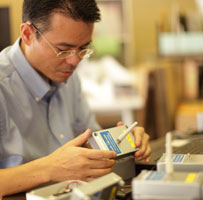 Returning to the topic of aquaticexercise let me tell you about the work we do in my lab in this area.We have successfully created the first aquatic pedometer in theworld. Aquatic walking is a suitable exercise for a wide range ofpeople from young to old. Although not many people enjoy aquaticwalking as it involves repetition of monotonous movements. In orderto make the exercise more enjoyable, we thought it would be useful toprovide information of interest to the person doing the exercise.Examples of such information include number of steps taken and numberof calories burned. This is one of the reasons why we started theresearch. After a process of trial and error, we developed an aquaticpedometer. It works as follows: The aquatic walker wears goggles towhich a sensor has been attached.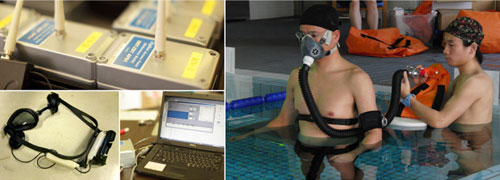
The data is then sent wirelessly from the sensor to a poolside antenna. The number of calories burnedis calculated using the data received and the personal data that hasbeen entered in advance. Such personal data include height, weight,age and gender of the athlete. The goggles are also equipped withbone conduction speakers, which enable information, such as theamount of calories burnt (for example 80 calories), to be sentdirectly to the athlete. Conventional pedometers measurecomparatively large movements on land, and it was believed thatmeasuring slow movements in water (where there is pressure) would beimpossible. I am always delighted to measure things that everyonethinks cannot be measured.
Extracting and using the necessaryinformation
 As technology advances in the future,we will be able to obtain large amounts of detailed information aboutathletes. The next area of research that needs to be tackled is datamining. This involves extracting important information from hugevolumes of information and then analyzing key information. Even if wecan obtain information of, for example the stroke of a swimmer or thegait of a runner, the answer to the question of how to move fasterdoes not lie in the data obtained. This means that eventually itwould take time to provide useful result to the athlete. It isdifficult to analyze the obtained numerical information and connectinformation to purpose. It is expected that a researcher not only hasaccurate knowledge of mechanics, but also possesses the experience asan athlete to analyze such information. Even if researchers were tofind a new method to enhance athletic performance, they would need toconvince the athlete to trust such results. As has been the case withother findings that are now widely accepted, these findings willprobably take some time to be accepted. We are still in the processof laying the foundation.
Sharing the joy of sports
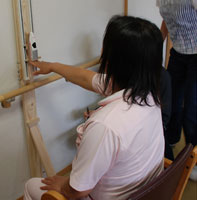 In early days of my career I was anathlete. However, my work is not only meant for athletes but foreveryone. The first aim of my research is to encourage people to playand enjoy sports. We are now conducting a joint research project witha corporation. We are doing research on exercise instruction forelderly persons at nursing care facilities. There are variousprograms for elderly in such facilities, and exercise is one of them.Take the simple exercise of opening and closing hands. Both personssuffering form dementia or recovering from a stroke conduct the sameexercise. Instructors sometimes wonder if the exercise is effective.If people who instruct and those who do the exercise understand thatthe recommended exercises will improve health, then both will bemotivated. I would like to quantify the effects of such exercises.The aim of my research is to motivate all, athletes and non-athletesalike, and help them enjoy sports.
A Brief Background of AssociateProfessor
Ohgi,Yuji
Associate Professor Ohgi graduated fromthe School of Health and Physical Education at the University ofTsukuba in 1990 and went on to earn a master’s degree in theMaster’s Program in Health and Sport Sciences at the sameuniversity in 1992. After completing coursework at the university’sDoctoral Program in Health and Sport Sciences in 1997, he left schooland headed SPINOUT, a company he established specializing inexperiments, data analysis, and software development for sports. Hebecame a Research Assistant at the Faculty of Environment andInformation Studies at Keio University in 1999. After serving asAssistant Professor, he became Associate Professor at the GraduateSchool of Media and Governance at Keio University in 2005. He earneda Ph.D. in Media and Governance at Keio University in 2003. AssociateProfessor Ohgi’s specialties include sports engineering and sportsbiomechanics.He is a member of the executive committee ofInternational Sports Engineering Association. He is currently amember of the Medicine and Scientific Committee of the Japan SwimmingFederation and a member of the JOC Scientific Staff. Patents forswimming goggles with bone-conduction speakers, swimming pool lanemarkers for people with visual impairments, a diagnostic system foranalyzing golf-swing form, and an aquatic pedometer.
(26 January 2010)
Archive