
From SFC, a boost to local communities!
SFC Associate Professor YoshinoriIsagai has always conceived local revitalization through humanresource development. With this idea in mind he has created the NPOHosujuku (The School for Fledgling Phoenixes) and the Toho VillageVitality Project. For him, “community building starts with buildinghuman resources”. In the following interview he discusses his workand the ways Japanese local communities can be revitalized.
ISAGAI,Yoshinori
Associate ProfessorFacuity of Policy Management
It may have all started with the“socialreformers brigade”
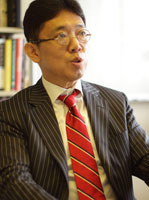 During my first job experience aftergraduating from university, I spent about two years in internationalmarketing. This made me acutely aware of how much more I had to studyabout business and management. I decided to leave my work to pursuefurther studies at the Graduate School of Business Administration,Keio University (The Keio Business School). My family runs awholesale company handling educational materials in Saga Prefecture.After completing my MBA, I went home to run the company. I worked invarious areas such as marketing, delivery, planning and management todevelop my ability and skill. After a year or two, I won a prize inan essay contest sponsored by the Saga Prefecture on proposals torevitalize local communities. My work interested many governmentcommittees of prefectures and policy-making bodies. Looking back atmy life, I can say that it was during this time that I began to getseriously interested in community revitalization. Recently, mymother told me something that surprised me. She said that I hadformed a group called “social reformers brigade” even before Iwas in kindergarten. Apparently, I gathered about 20 neighborhoodchildren to go around checking for hazards near the kindergarten, andto tell the grown-ups, “Please be sure to get this fixed”. Itseems as if in my childhood I had the making of a localrevitalization activist.
Fostering “fledgling phoenixes(future heroes)”
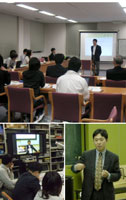 Regional cities offer subsidies andbusiness incubators to start business ventures and run businesses ofvarious kinds. Such support is underutilized even today, but therewere even fewer people then making use of such support system when Iwas in Saga. I concluded that what local revitalization needed was astructure for human resource development and a learning community, inwhich a group of people learn from one another about the practicalside of management. In 2000, acting on the proposal outlined in myaforementioned essay, I launched the Hosujuku to help fosterentrepreneurship in Saga. The school’s training program did notrely on the one-way teaching method of management theory. Instead, itencouraged students to come up with original solutions, and thendiscuss those solutions amongst themselves. I believe thatresourceful people who can come up with their own solutions are whatwe most need to revitalize local communities. Today, the Hosujuku hasgrown into a full-fledged community of highly motivated people whoare working at resolving many different social issues. Humanconnections are steadily proliferating amongst organizations andindividuals. The Hosujuku has been established in many places aroundthe country besides Saga, such as Toyama, Kanagawa and Saitamaprefectures. During the seven years I spent in Saga, I confronteddifficult situations and that led to some frustration as well. Today,all such experiences are part of my good memory. My experience inSaga proved quite valuable in revitalizing local communities(machizukuri). My work in this area has given me first handexperience about rural communities and small-and-medium sizedcompanies.
How to create vital communities
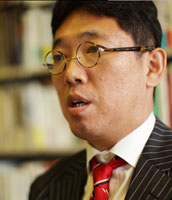 In 2002, I returned to the BusinessSchool at Keio University. This time I conducted academic research inthe doctoral program. In 2005, I came to the Shonan Fujisawa Campus(SFC) as an Assistant Professor in the Faculty of Environment andInformation Studies. The following year, our lab was asked by FukuokaPrefecture to do a preliminary study for setting up a broadbandnetwork in a place called Toho Village. The village was a newlycreated municipality formed by the merger of smaller units, and itwas without a broadband network. After considering a number offactors, we thought the best approach would be to set up a network,and then capitalize on it for community building. We thereforelaunched the Toho Village Vitality Project. The aim of the projectwas to train people in the village as machizukuri leaders who coulduse information technology to advertise the attraction of thevillage.
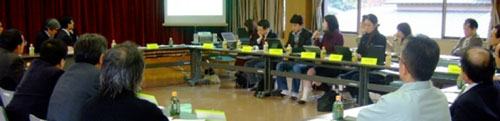
When laying the groundwork to promotelocal development, we need to identify local resources, create aconsensus on communal assets, and advertise our strength. We callthis the “resourcifying process”. In order to smoothly facilitatethe “resourcifying process”, it is essential to have a leader whocan coordinate the process. Even if potentially useful resources areidentified, local development initiative could fail to grow withoutthe phase, where community members create a shared vision andcommunicate effectively to the outside world. In local developmentactivities, people do not work the same way as they do in acorporation. Community leaders cannot assign tasks to someone or payhim/her to expand activities. This is where high-level managementskills come in. The key here is to train people in human resourcemanagement and then make them enter the actual situation and resolveproblems. In the case of Toho Village itself, there were many knottyproblems and challenges. Thankfully, a leader emerged who could bringa team together to find solutions. It struck me that when a communityproduced such a leader, it could change. Many local people alsoparticipated in the project in the hope of making a difference intheir community. The project was a great success. During the projectwhich lasted about a month, some 30 students from SFC went to TohoVillage and made themselves very useful. For example, studentssupplied technical assistance in areas like image editing and gaveadvice on the resources of the village from a different perspective.The mayor was highly impressed by our work and he said that “amiracle has happened here”. I was deeply moved by his words.
Revitalizing the regions can improveJapan
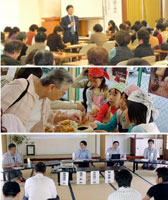
 I think that Japan as a whole will berevitalized as unique local initiatives are launched around thecountry. These initiatives can serve as models that can inspire othercommunities nationwide. Japan cannot be changed all at once.Therefore, what I intend to do is to create a structure thatencourages such initiatives. The first structure is to “develophuman resources”. Local initiatives cannot become national if wemerely copy the successful program of a community and use it onanother. Each locality needs its own machizukuri leader (coordinator)and unique initiative. The second structure is to “collaborate withstudents from various universities”. I believe that many communityrenewal and machizukuri programs would benefit from the involvementof various universities. Energetic and innovative young talentsinvariably gather in universities. These students are a great asset,a precious resource for the regions. Communities that embrace theirenthusiasm and perspective will thrive. As this collaborativeendeavor spreads across the country, Japan will be revitalized. Iwould like to help create this momentum.
Aiming for “knowledge combined withaction”
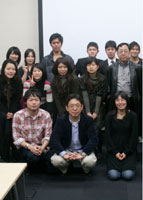
 I expect students studying at SFC tobecome leading innovators in the world. Many of them proactively workon practical projects and achieve remarkable results, and get highgrades in coursework and assignments at the same time. I think SFC isunique amongst Japanese university campuses in attracting suchstudents. The motto of my seminar is “knowledge combined withaction”. It means that one can learn something only by putting itinto practice. I always urge my students to take advantage of whatthey have learned in classes and seminars and apply it toproblem-solving activities and projects. Integration of theory andpractice for problem-solving gives rise to synergies. I am delightedto see many students join hands to work together and learn from eachother’s experience. My classes often take the form of a discussion.Sometimes we get into such intense debates that we run out of time. Ienjoy teaching these classes because students have a great deal ofintellectual curiosity. I believe such students can make abreakthrough that our society needs today. I am looking forward toseeing them become leaders who can resolve not only national butinternational problems as well.
A Brief Background of AssociateProfessor
ISAGAI,Yoshinori
Associate Professor Isagai was born inSaga in 1964. He holds a Ph.D. in Business Administration from theGraduate School of Business Administration, Keio University. Hisfield of interest includes management information systems, regionalinformatization and community development. He joined MatsushitaElectric Industrial Co., Ltd. in 1987. While he was working for theaforementioned company, he was seconded to Fujitsu Limited. In 1992,he enrolled as a student in the Keio Business School. On completinghis MBA in 1994, he joined the Isagai Corporation and became itsmanaging director in 1997. In 1999, he founded the NPO Hosujuku(later a specified nonprofit corporation) to provide entrepreneurshiptraining to students. He established the Ether Guy Corporation in2001 and served as its representative director. He was appointedAssistant Professor in the Faculty of Environment and InformationStudies, Keio University in 2005, and has held his present positionsince 2008. He has worked on the conference relating to the issue ofdepopulation and served on the advisory council creating regionaladvantage for the Ministry of Internal Affairs and Communications,and as an advisor to the same Ministry on regional informatization.
(06 January 2010)
Archive