
A stunning design arises from observing the core instead of the periphery
Professor Shunji Yamanaka, one of theleading industrial designers in Japan, has been creativelychallenging the boundaries between design and science in projectsranging from the design of automobiles for the common public to thedesign of artificial limbs for track-and-field athletes. He spokewith us about his ideas, vision and reminiscences as a designer.
YAMANAKA, Shunji
ProfessorGraduate School of Media and Governance
When I was a student, all I did was todraw manga
 I went to an academic high school notto an art and design school. The school I went to is known forsupplying smart students to top universities in Japan. During my highschool years I just concentrated on passing the entrance examination.Consequently, I was able to pass the entrance examination for theUniversity of Tokyo. Once I was admitted to the university, I lostsight of my goals. It was, so to speak, a late case of spring fever.Around the beginning of my sophomore year, I idly began to copycharacters from the comic book I placed beside my desk to take abreak from studying for tests. The drawing was unexpectedly good. Iwas engrossed in drawing throughout the night into the wee hours ofthe morning. Next day I could not do well in my test. However, thisexperience encouraged me to join the Manga Research Club at theuniversity. For the next two years, I did nothing but draw manga withmy friends at the club. Once, my original manga drew attention fromprofessional manga publishers at a comic book fair. I thought ofmaking a career as a manga artist, but I felt this would disappointmy parents. Even when I became a senior student, I still had no ideaof what I was going to do after my graduation. One day, a friend ofmine told me that one could make a career out of “industrialdesign”. I thought this could be the kind of work I could make thebest use of my talent as a mechanical engineering at the Faculty ofEngineering and a manga artist.
Nissan was like a school of design
 I started my research on industrialdesign hoping to make it into a career. Meanwhile, a professor at myuniversity introduced me to the General Manager of the DesignDepartment of Nissan Motor Company. I assume the professor describedme as an oddball student at Tokyo University who wants to be adesigner. Meeting with the General Manager made me incrediblyattracted to the auto designing. I asked him on the spot if he couldhire me. Later I brought him illustrations of my manga and designs ofcars in two paper bags. I was hired after few more interviews.TheNissan Design Center was an amazing place. I thoroughly enjoyedworking there as I loved to draw and make things. I acquired most ofknowledge and skills I needed for industrial design on the job. Atthe time, auto design was a leading-edge field that had beenattracting the most talented designers. It was also the place for thestate-of-the-art designs in the world. I was satisfied with my work,but there was one thing that was different from what I hadanticipated. I was hoping to be more involved in designing coreelements of automobile. However, work assignments were divided intosmaller groups than I thought. That meant that designers only plannedhow to package the internal structure, while engineers determinedmost of the basic performance and specifications. I gradually becamemore interested in designing core elements, as well as externalappearance. After five years with Nissan, I decided to become afreelance industrial designer.
Working as an industrial designer
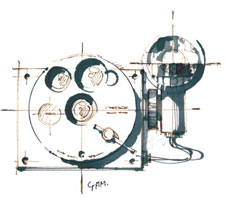 Not long after I became a freelanceindustrial designer, Mr. Naoki Sakai, who had already made a name forhimself as a concept designer, approached me with the idea ofdesigning a camera together. With Mr. Sakai’s concept and mydesign, we created the “O-Product” for Olympus Corporation in1988. This product won international acclaim. Later in 1995, it waseven included in a special exhibit at the Museum of Modern Art.Through numerous works I did with Mr. Sakai, I learned a lot from himon how to structure a business deal to business protocol and publicrelations in making a presentation. Both of us are now professors atthe Graduate School of Media and Governance at Keio University.
The university is a gold mine
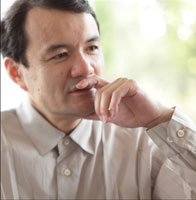 In 1991, I became an assistantprofessor at the University of Tokyo. Looking around at various labsand research seminars on campus once again, I felt that theuniversity is a gold mine—a resource of design concepts and afertile technological ground for new products. In the corporateworld, a product is made by giving a structure and design topartially developed technology. I felt if one could directly nurturetechnological seeds, more imaginative products could be created.However, I had no idea about where I should begin. As I discussedabout my thoughts in my classes, students with the same interest indesign emerged. Slowly, the idea of designing things imaginativelybegan to happen. In 1994, I launched a company called “Leading EdgeDesign” to work in this area. But it took a few years to develop.In 2000 we finally began to create products that were creative enoughto interface design and technology.
SFC succeeds in eliciting ideas fromstudents
 Starting around 2006, I was invited toSFC several times as a guest lecturer in the Design Language course.At SFC, I met professors such as Akira Wakita and Hiroya Tanaka. Theyare researchers who conduct research on media art while teachingelectronic engineering. I felt that I had found like-mindedindividuals at SFC. Though they are not specialists in design orengineering they are nevertheless pursuing their own way of makingthings. Later I worked with Associate Professor Wakita on acollaborative project called “Ephyra”. I met a number of SFCstudents in the process. It seemed to me that SFC students have highmotivation and ability to take action. I thought that it would be funto do more work with them. Eventually I was asked to join the facultymembers of the Graduate School of Media and Governance.Since I cameto SFC, I have observed that SFC is unique in the way it conductseducation and elicits ideas from its students. If you give the sametask to first-year through fourth-year students, there is a cleardifference in the kind of ideas they offer. Perhaps, at otheruniversities, freshmen may come up with better ideas than theirseniors. These students may acquire an immense body of knowledge andskills in their professional education, but most of them do notacquire the ability to produce new ideas. I think students at SFCposses the ability to be creative in almost all fields.
Learn from the skeletons of the past to
design structures for the future
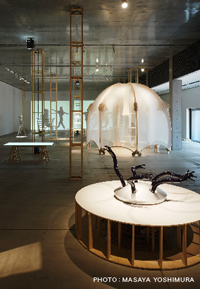 Until the end of August 2009, the“21_21 DESIGN SIGHT” (a design exhibition space in Tokyo Midtown,Roppongi) was featuring the exhibition called the “bones”. Thiswas the exhibition I directed. Discussions regarding this exhibitionbegan three years ago. As a director I decided the theme, the spacedesign and the works to be displayed. The major theme of theexhibition was to “think about the approach of making things fromcore elements”. People might think design only means an externaldesign, but it is extremely important to think from the bones or theskeleton. In other words, the technological core is most important inorder to create products that are beautiful and useful. Theexhibition was divided into two parts, the “specimen room” andthe “lab”. In the “specimen room”, we collected a largenumber of animal skeletons and the structural skeletons of variousindustrial products for display. In the most refined, precise andcomplex structures of industrial products, one may feel the presenceof life force akin to that one may sense in the bones of livingthings. If the viewer could feel such a life force, I would be happy.I invited ten creators—designers, engineers, artists, a mechanicaldoll maker, etc.—to contribute pieces that would be based on“thinking from the bones” for the lab. All of these hands-onworks entertained participants. We were convinced that the idea of“thinking from the bones” will help us to get a new experience.
Creating physical design, usingleading-edge technologies
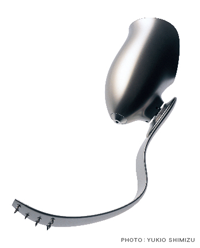 Beginning in April 2009, the faculty ofX-Design Program at the Graduate School of Media and Governancelaunched a project at SFC called “Factory of X-Design”. What wewanted to do was to equip SFC with the machine tools that will makeit possible to directly produce things. The more computer technologyon the Internet become sophisticated, the more serious questionsarise such as: “What kind of effect does this have on our physicalenvironment?” and “How can we connect this virtual world with ouractual lives?” We aim at creating a prototype that will clarify therelations between physicality and leading-edge technology. The firststep in that direction is to use robotics as a medium of expression.The piece called Flagella in the “bones” exhibition is of noimmediate practical value, but suggests a totally new structure andrealizes unusual and intriguing patterns of movement. I would alsolike to get more involved in the design where there is a directconnection between the human body and machines. I am currentlyworking on the research to produce “aesthetically pleasingartificial limbs for sports use” with Paralympic athletes andartificial limb specialists. It is my dream that someday an athletewith beautiful artificial legs will win a gold medal in theParalympics.
A Brief Background of Professor
YAMANAKA, Shunji
Professor Yamanaka graduated from theFaculty of Engineering, the University of Tokyo, in 1982. He joinedNissan Motors Design Center the same year, and became an independentindustrial designer in 1987. He became Assistant Professor in theUniversity of Tokyo, Faculty of Engineering in 1991 and stayed at theuniversity until 1994. He founded Leading Edge Design in 1994 andserves as the president of the corporation. He was appointed as theProfessor of the Graduate School of Media and Governance, KeioUniversity in 2008. He is a creator of numerous products and basictechnologies—from automobiles, cameras, watches, robots, mobilephones, furniture to the design of interface for mass-transit smartcard machines—based on a design approach fusing art and technology.He is the winner of numerous awards, including the 2004 MainichiDesign Award and the Gold Medal at the 2006 Good Design Awards.
“bones,”an exhibit directed by Shunji Yamanaka at 21_21 DESIGN SIGHT
XDesign Program at the Graduate School of Media and Governance, KeioUniversity
(11 December 2009)
Archive