
Eliica, The Future in a Car
"Eliica" Electric-vehicleDevelopment Project
SHIMIZU,Hiroshi
ProfessorFaculty of Environment and Information Studies
Drive it, and you'll understand
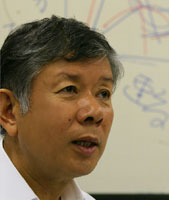 “Seeing is believing,” or, as weprefer to call it in the auto industry, “driving is believing,”points out the leader of the development project, Professor HiroshiShimizu of the Faculty of Environment and Information Studies.Professor Shimizu is trying to explain the super eco car calledEliica in a nutshell. Eliica is a complete electric vehicle, a motorvehicle that has lots more things under its hood than you canimagine. If you just call Eliica an “electric car” most peoplemight imagine a motorized golf cart. But this vehicle completelyoverturns the notion of a slow-moving motorized vehicle. The Eliicawas originally designed to run at a maximum speed of 400km/h. Iteasily hits a top speed of 370km/h in no time. The feeling ofacceleration in this car may go beyond your imagination. Evaluatingits acceleration Professor Shimuzu concludes, “The feeling ofacceleration is intense! No shifts or interruptions… just smoothacceleration all the way through.” To find sleek, flowing contoursin an electric car and feel, on acceleration, the sense of gravityslipping away is just inconceivable in a gasoline car. “Driving isbelieving” sums it up. Drive it, and you'll understand. The carbrings the future at your doorsteps. “All boys love cars,”Professor Shimizu intones. When we were little we all dreamed aboutour ideal future. This high performance electric car, the Eliica,makes your heart race in exactly the same way as when we were young.
I love cars more than anything else
 Being asked what other means oftransport he liked, Professor Shimizu said, “There isn't any other.I just love cars.” It is probably fair to say that now that theEliica is complete makes it the happiest moment in ProfessorShimizu's life. But it has taken thirty years of painstaking devotionfor this to come true. When Professor Shimizu was studying at theSchool of Engineering he always dreamed of becoming an automotiveengineer. He was one of the many baby boomers who joined the workforce when Japanese driving culture was drawing heavy criticism fromall quarters for its high traffic accidents and increasing airpollution. Professor Shimizu hesitated to enter the automotive worldand pursued his study in the field of applied physics to begin withthe basics. In graduate school, he studied about lasers, which werethen considered both pioneering and cutting-edge research. Upongraduation he joined the National Institute for Environmental Studiesin the Ministry of the Environment, where he participated in thedevelopment of a system that employed laser light to measure airpollution. The development of the laser light system proceededsmoothly and he gained the satisfaction of designing somethingspecial and useful. It is perhaps ironic that Professor Shimizu gothis start as a researcher developing machines to measure airpollution, invariably referred to as the Achilles' heel ofgasoline-powered cars. But as he pursued his studies in environmentalpollution, he soon realized that measuring air pollution was not thesame as fixing it. At last he came to a conclusion that the mostenterprising way to overcome air pollution was to develop anemission-free electric car. At this time most experts in theautomobile industry were aware that eliminating CO2 emission wouldundoubtedly improve the environment. But nobody was ready to take thenext step. But Professor Shimizu felt that knowing the answer withouttaking action was meaningless. “There's no point in switching toelectric cars unless they're better than gasoline cars in some way.All developments in manufacturing are driven by this very process ofindustrialization,” Professor Shimizu argued.
Always five years away
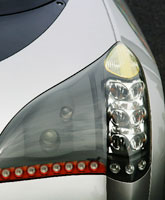 Early in its development, the Eliicaproject realized that the development of an electric car and theproliferation of its technology would have a salutary effect on theenvironment by fighting global warming. In the beginning the eco carteam brainstormed a medley of ideas, tested various suggestions andanswered many “what ifs.” Gradually the idea of an eco car calledEliica emerged. Slowly its skeleton began to be fleshed out. “Wecan get this project done in five years!” Professor Shimizu thoughtin those days. Five years later, he thought the same, and five yearshence he felt the same. After that…before he realized it, theEliica project had taken nearly 30 years. However these three decadeswere quite satisfying as they afforded a chance to flesh out arevolutionary idea. All along he was confident that “Our effortswould eventually pay off.” This positive outlook was what led himto ultimate success. Diverse physical principles call forexperimentation with different conceptual forms and designs.Professor Shimizu's team threw away antiquated ideas and started todevelop a new energy-saving model. It was a pioneering work inautomobile design that could only be done in Japan. The team employedmost of the new technology including a high-energy Lithium-ionbattery, in-wheel motors, and a high-performance inverter.
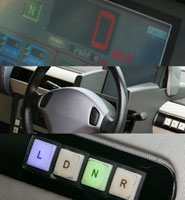 All thesenew technologies were finally incorporated in the Eliica model.Though Eliica is a breakthrough development, Professor Shimizu humblystates that his achievement is quite small as the unrealizedpossibilities of the concept are limitless. Undoubtedly a lot ofgroundbreaking work gets lost in the process leading up to thedevelopment of a prototype. This was a matter for concern for theteam which was aware of the history of failure of such universityventures. To add to their anxiety, both Professor Shimizu and histeam were apprehensive about the seemingly unbridgeable gap betweenbasic and developmental research called the Devil River. But to theirrelief and joy this gap was bridged by both ingenuity and creativityand the fragile technological flower called Eliica bloomed. The nexthurdle, called Death Valley, is to transform the prototype into acommercial product. The technology needs to prove its reliability,durability and safety. Professor Shimizu determined, “I will walkslowly on the edge of the valley, and I will manage to cross it.”Without overcoming this valley, the electric car Eliica would not beable to replace gasoline cars. The last challenge to overcome is tomake the commercial product suited for mass production, known asDarwin's Sea. The team is confident that they will be able to bridgethe gap between commercial production stage and mass production byjust working consistently on research and development. They know theyhad worked hard and success will surely be theirs.
SFC is the secret
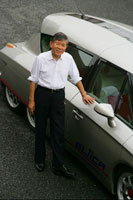 It is no exaggeration to mention thatthe intellectual culture of Shonan Fujisawa Campus (SFC)provided the critical backdrop for the Eliica project to takeoff. Suppose one researcher asked himself, “How do we want tochange society?” Then, his question develops in his mind from “Whatkind of car would achieve that result?” into “In what way do carsneed to change?” He continues to ask himself, “Once we have thisadvanced car, how do we persuade people to adopt it?” Thesequestions helped to expand the possibilities of the projectlimitlessly. From design, motor development and core component designto creation of business model and marketing, the project grew into anenormous structure. “You can look all over the world, and SFC isthe only single campus where such a comprehensive project can bedeveloped from concept to fruition,” Professor Shimizu enthused.“That's why this campus is capable of such stellar researchresults.” This ideal educational framework that SFC providedenabled Professor Shimizu and his project team to transform theconception of the Eliica eco-car into reality. Professor Shimizu withhis team is now eager to start the Eliica revolution, something thatbegan with the basic question of how to change daily life.
A Brief Background of Professor
SHIMIZU,Hiroshi
Professor Shimizu completed hisdoctoral studies at the School of Engineering, Tohoku University.Upon graduation, he accepted a post at the National Institute forEnvironmental Studies. Later, Professor Shimizu attended an overseasstudy program at the University of Colorado in the United States.After stints as director of Regional Planning Research Office of theNational Institute for Environmental Studies and Director of Researchat the Regional Environmental Research Group of the NationalInstitute for Environmental Studies, Professor Shimizu in 1997 wasappointed professor at the Faculty of Environment and InformationStudies, Keio University. Since then he has served as GeneralTechnology Leader of the Eliica Electric-vehicle Development Project.He is now spearheading a team to promote the sales of thisrevolutionary vehicle. Professor Shimizu's area of specialization isresearch in technology aimed at analyzing and solving environmentalproblems. Currently his key duties involve the development of theelectronic vehicle and a database of environmental technology. Hisinterest in electric car research and development of electric carsgoes back to his work at the National Institute for EnvironmentalStudies. In 2004, after developing seven prototypes, ProfessorShimizu and his team succeeded in making Eliica a reality.
(18 December 2008)
Archive